Whether it’s tackle football or flag football, women or men, seasoned adults or young schoolchildren: with small rule adjustments, the core idea of American football can be played in many different forms.
What fascinates fans is the chase for touchdowns, quarterback sacks, and the pursuit of the ball carrier in every imaginable way. It’s no coincidence that American football is the most popular sport on TV in the United States — and rapidly gaining ground worldwide. Few sports deliver as much dynamism, excitement, and spectacle in just two to three hours, whether on the screen or live in the stadium.
Across the regional associations of the AFVD, more than 73,000 people are dedicated to this thrilling sport and/or cheerleading. And cheerleading as well: a high-performance sport for women and men at the top level — not just dance, but also elements that would fit into the most demanding gymnastics routines.
Of course, at the ERIMA GFL Bowl in Rudolf-Harbig-Stadion we will see the two best men’s tackle football teams on the field. But the event program will showcase the full diversity of the American Football Association of Germany. Players, coaches, cheerleaders, and referees shape the identity of American football from Flensburg to the Allgäu, from Saarland to the Ore Mountains.
It’s time to dedicate the biggest celebration of the AFVD entirely to them again. Naturally, the cheerleaders will play their classic role in creating the game-day atmosphere: spreading excitement, energy, and great vibes. But they — like all other active participants — deserve to be entertained beyond that, with a program worthy of the dedication they show throughout the year.
This is one more reason why a visit to the ERIMA GFL Bowl will be worthwhile for the whole family — a wide selection of food and beverages awaits all visitors.
Various guests and DJs will provide live music. The national anthem will be performed in the stadium before kickoff, and afterwards a dignified trophy ceremony will honor the athletes at center stage. Expert stadium hosting and the right music at the right time will help maintain the flow of the game throughout the arena.
And what truly creates the unique goosebumps atmosphere of the ERIMA GFL Bowl is already clear: the fans and members of German football clubs who will travel from near and far, bringing their trademark creativity to support one of the finalists — or proudly represent their own club. To encourage these fan initiatives, special group discounts will be available for clubs — on top of the already affordable regular ticket prices.
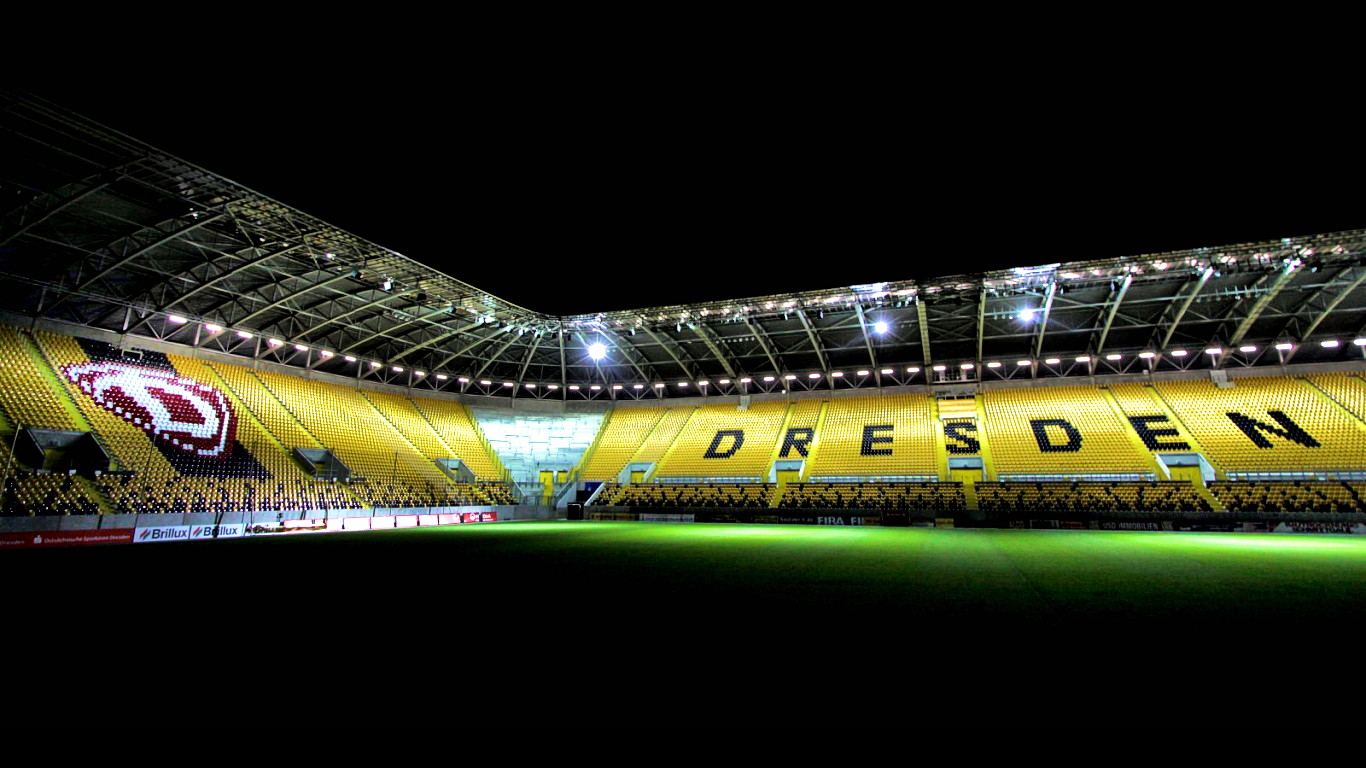
With the opening match on September 15, 2009, the most emotional venue in the city of Dresden was brought to life. Ten years later, the Rudolf Harbig Stadium is known throughout Germany. The thrilling home games of SG Dynamo Dresden and numerous major events show that the heart of the state capital beats at Lennéstraße 12.
The key figures of Germany’s steepest single-tier stadium are a series of superlatives. More than 32,000 guests can be accommodated under the roof of the arena, which opened in 2009. 19,502 black-and-yellow seats and 1,170 padded VIP seats await the visitors. And 11,050 standing places – 9,055 of them in the North Stand alone – reflect the unique football culture in Dresden. There are also 18 exclusive suites and 119 press seats located 30 meters above the ground. The accessible stadium area covers 72,000 square meters, including parking spaces for nearly 700 cars and 184 bicycles.
The impressive structure is approximately 195 meters long and 160 meters wide. The reinforced concrete building comprises five floors and is clad with a 2,000-square-meter transparent glass façade. The stands, including the new family section, are made of around 8,000 precast concrete elements. The roof is constructed as a steel truss structure with a surface area of 19,000 square meters, two-thirds covered with trapezoidal sheet metal and one-third with synthetic material.
The stadium features two video boards, each measuring 42 square meters, and more than 184 floodlights. The lighting intensity of the floodlights is 2,000 lux – almost twice as bright as the former “giraffes.” An emergency power generator ensures uninterrupted game operations. The arena equipped with state-of-the-art technology cost around 43 million euros. An investment that pays off – for football, American football, and for the city of Dresden.
| Total | 20,310 visitors (limited to 20,000 by building regulations) |
| Standing places | 9,040 visitors |
| Seating | 11,270 visitors (total) |
| Business seats | 1,061 visitors (usually linked to seating in the Business Club) |
| Press seats | 138 visitors (23 fixed desks, 115 folding desks) |
| Wheelchair users / companion seats | 46 + 46 visitors |
| Sparkassen Lounge (large suite) | 81 visitors |
| Suites 1 to 10 total | 274 visitors |
| Total capacity | 32,249 |
| Seating | 21,055 |
| Standing | 11,050 (including 9,050 in the home section) |
| Away fans | 2,000 |
| VIP seats | 1,548 |
| Suite seats | 196 |
| Suites | 18 suites à 30 m² (for 10–11 persons) |
| Press seats | 144 |
| Wheelchair users | 56 + 16 companions |
The Stadium
The Rudolf-Harbig-Stadion