
Tuesday 29.09.26
11:00 a.m.: Press conference in front of the Bowl
Official press conference for the 2026 GFL Bowl with representatives from the finalist teams. For members of the press only. Please register by email at t.goepfert@gfl.info
Location: MS Gräfin Cosel, a ship operated by Sächsische Dampfschifffahrt
Friday, 02.10.26
6:30 p.m.: Hall of Fame and GFL Honors Night
Honoring the best players and the best coach of the 2026 GFL season and inducting new Hall of Fame members by the AFVD.
Closed event!
Saturday 03.10.26
2:00 p.m.: Pre-Game Party Begins
4:30 p.m.: Stadium and VIP entrance
5:00 p.m.: Pre-game show at the stadium
5:50 p.m.: National Anthem
6:00 p.m.: Kickoff
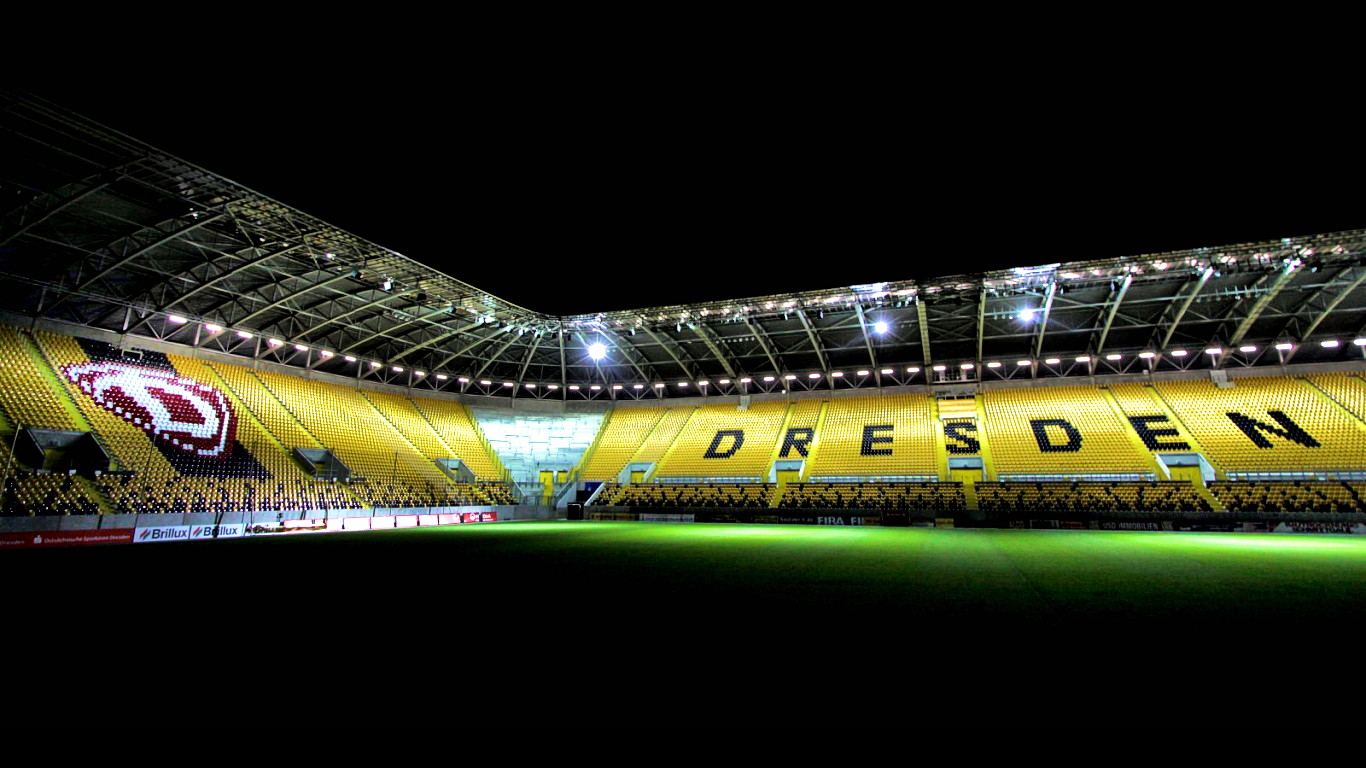
With the opening game on September 15, 2009, Dresden’s most emotionally charged venue came to life. Ten years later, the Rudolf-Harbig-Stadion is known throughout Germany. The thrilling home games of SG Dynamo Dresden and numerous major events show that the heart of the state capital beats at Lennéstraße 12.
The key figures for what is currently Germany’s steepest single-tier stadium are a string of superlatives. More than 32,000 guests can be accommodated under the roof of the arena, which reopened in 2009. 19,502 black-and-yellow seats and 1,170 upholstered VIP seats await visitors. And 11,050 standing-room-only spots—9,055 of which are in the North Stand alone—reflect Dresden’s unique soccer culture. In addition, there are 18 exclusive boxes and 119 press seats at a height of 30 meters. The accessible facility spans 72,000 square meters, including parking lots with space for nearly 700 vehicles and 184 bicycles.
The imposing new building is approximately 195 meters long and 160 meters wide. The reinforced concrete structure comprises five stories and is clad with a 2,000-square-meter transparent glass façade. The spectator stands, including the new family section, consist of approximately 8,000 precast reinforced concrete elements. The roof is designed as a steel truss structure with an area of 19,000 square meters. Two-thirds of this area is made of trapezoidal sheet metal, and one-third is covered with a plastic membrane.
The stadium features two video scoreboards with j
| Gesamt | 20.310 Besucher (gem. Baugenehmigung auf 20.000 begrenzt) |
| Stehplätze | 9.040 Besucher |
| Sitzplätze | 11.270 Besucher (gesamt) |
| Business Seats | 1.061 Besucher (i. d. R. mit Platz im BusinessClub verbunden) |
| Presseplätze | 138 Besucher (23 feste Tische, 115 Klapptische) |
| Rollstuhlfahrer / Begleitplätze | 46 + 46 Besucher |
| Sparkassen Lounge (große Loge) | 81 Besucher |
| Logen 1 bis 10 gesamt | 274 Besucher |
| Gesamt-Kapazität | 32.249 |
| Sitzplätze | 21.055 |
| Stehplätze | 11.050 (davon 9.050 im Heimbereich) |
| Gästefans | 2.000 |
| VIP-Plätze | 1.548 |
| Logen-Plätze | 196 |
| Logen | 18 Logen à 30 m² (für 10–11 Personen) |
| Presseplätze | 144 |
| Rollstuhlfahrer | 56 + 16 Begleiter |
Stadion
The Rudolf-Harbig-Stadion